This educational resource on carbon credits was developed through the First 30×30 Canada Program, an initiative led by Nature For Justice in partnership with IISAAK OLAM Foundation and Nature Focus Development, in collaboration with the RAD Network.
The graphic outlines the process of how carbon credits are produced and sold through Indigenous-led land stewardship initiatives. From defining a carbon project and validation audits to credit issuance, sales, and reinvestment, the process demonstrates how verified climate benefits can generate long-term revenue streams that support stewardship, governance, economic sovereignty, and Nation-building.
Explore Emerging Nature-Based Financing Approaches, a resource created by the First 30×30 Canada Program, led by Nature For Justice, in partnership with IISAAK OLAM Foundation and Nature Focus Development, in collaboration with the RAD Network, that supports Indigenous-led conservation, stewardship, and long-term economic sovereignty.
Designed for Indigenous practitioners, communities, and partners, this resource highlights a range of financing tools, including partnerships, co-investment, carbon and biodiversity markets, ecosystem service payments, public funding, and community-driven economies.
Rather than promoting a single model, we recognize that nature-based financing is place-based, relationship-driven, and rooted in community priorities. Diverse financial strategies can support stewardship while aligning with Indigenous governance, values, and long-term goals.
As a living document, it reflects a rapidly evolving landscape and will continue to grow alongside emerging practices and innovations in the field.
The First 30×30 Program, led by Nature For Justice in partnership with IISAAK OLAM Foundation and Nature Focus Development, has collaborated with the RAD Network to develop a resource on Atmospheric Benefit Agreements (ABAs) within British Columbia’s carbon governance framework. This resource explains how ABAs are used to define the allocation of carbon offset credits for projects on Crown-classified public lands, and how they support clarity, revenue generation, and market confidence in carbon projects. Grounded in the recognition of Indigenous rights and ongoing jurisdictional considerations, this resource is designed to support informed, strategic, and self-determined decision-making for Indigenous governments and partners navigating carbon opportunities.
The First 30×30 Program, led by Nature For Justice in partnership with IISAAK OLAM Foundation and Nature Focus Development, has collaborated with the RAD Network to offer a resource highlighting British Columbia’s Forest Carbon Offset Protocol (FCOP), outlining how forest-based carbon projects are developed, measured, and verified within the province’s regulatory system. This resource explains how carbon offsets function as a tool for reducing greenhouse gas emissions while supporting conservation and ecosystem stewardship. Grounded in the recognition of Indigenous rights and ongoing questions of jurisdiction, this overview is designed to support informed, strategic, and self-determined decision-making for Indigenous governments and partners exploring carbon opportunities.
A reflection on how we work within flawed systems to support Indigenous leadership, conservation, and sovereignty.
Facing the Hard Truth
Much of our work at Nature For Justice intersects with carbon offsetting and the broader nature-finance market. It is a space full of tension. Carbon markets have the potential to mobilize significant resources for conservation and Indigenous stewardship, yet they have also produced harm when poorly designed or implemented. Globally, these spaces have historically been rife with predatory developers, inequitable benefit-sharing with local communities, and systemic barriers that prevent Nations and other Indigenous governments from fully benefiting from conservation finance. We have been vocal about these issues, and Indigenous leaders worldwide have highlighted the risks of poorly designed carbon projects that misrepresent conservation outcomes or displace Indigenous People.
But an honest conversation must go further: Carbon offsetting itself is a flawed system. It is complex, unevenly regulated, and often out of alignment with Indigenous worldviews and values.
We of course are not the first to point this out, but as we work within this space, it is critical for us to we acknowledge that:
Carbon markets commodify what is sacred. The value of a forest, waterway, or ecosystem cannot be reduced to CO₂e or the price of a credit. Their cultural, spiritual, and ecological significance far exceeds any economic metric. Learn more at https://nature4justice.earth/the-risks-of-nature-commodification/.
Not all offsets successfully reduce gross overall emissions. As emission trading systems allow continued pollution in exchange for reductions elsewhere, offsets manage harm, they do not eliminate it. Pollution continues, and its impacts are felt most intensely by Indigenous and marginalized communities. At the same time, some companies participating in carbon markets are working to reduce their emissions year over year as part of broader transition strategies. While offsets alone cannot solve the problem, they can play a supportive role when paired with genuine reductions at source.
Offsets operate within socio-economic systems that created climate injustice in the first place. Many of the industries responsible for significant greenhouse emissions are now being asked to contribute financially to climate solutions. There is no guarantee that these payments will go to those who have historically not contributed to greenhouse gas emissions. Offsets will not end climate change on their own, but the resources flowing through these markets are significant.
While we recognize the flaws and shortcomings of carbon markets, we see it as imperative to leverage existing resources and institutions to build a better world. At First 30×30 Canada, led by Nature For Justice, in collaboration with IISAAK OLAM Foundation and Nature Focus Development, we are committed to redirecting the financial flows of nature-finance toward Indigenous sovereignty, land protection, and long-term nature stewardship.
Working Within Imperfection
If carbon markets are imperfect, the question becomes: Can we use flawed tools to advance Indigenous rights, conservation, and Nation-building?
We believe the answer is yes. If Indigenous leadership is at the centre, and if integrity is non-negotiable.
Two of the most persistent failures in today’s carbon markets are also areas where Indigenous Nations hold the strongest solutions:
Concerns about project quality, permanence, and long-term stewardship —Indigenous Nations have lived in reciprocity with their territories for millennia. Their long-term stewardship provides the permanence and integrity the market struggles to guarantee.
The market’s failure to value Indigenous knowledge, rights and responsibilities —Indigenous stewardship is one of the most powerful climate solutions on earth, yet it remains underrecognized and underfunded. First 30×30 helps correct that imbalance by ensuring Nature-based Solution (NbS) projects honour Indigenous law, land relationships, and knowledge systems. Indigenous leaders point out that their work is not about securing rights, but rather about securing their ability to carry out their responsibilities to their territories – responsibility to care for the animals, plants and ecological systems that have co-evolved with them.
When implemented through Indigenous governance, carbon and NbS projects can protect critical ecosystems, strengthen local economies, and fund long-term stewardship, all while advancing rights recognition and traditional knowledge for how to live in good relationship with the unique living systems that make up Planet Earth.
Navigating This Work
Nature finance is only one tool within a broader movement for Indigenous sovereignty, climate justice, and economic self-determination. Courts, negotiations, frontline resistance, language revitalization, land-based teaching, and governance rebuilding are all part of this movement – and carbon finance can support this movement when used carefully and ethically. This understanding shapes how we approach nature finance in practice. Rather than rejecting imperfect systems outright, we focus on building safeguards, accountability, and Indigenous leadership into every step of the process. This perspective guides the steps we take in our work, beginning with the following principles:
1. Carbon as a means…not an end.
Our starting question is never “How do we generate offsets?” It is: “How do the Indigenous leaders for an area want to care for their territory, and how do we secure long-term financing that supports this vision?”
When structured through clear, enforceable, equitable Benefit Sharing Agreements, carbon revenues can provide long-term income that reduces reliance on unpredictable grant cyclesand supports true Nation-building. When the price of carbon is set at strong and dependable rate by government systems, the long-term benefits are even greater.
2. Projects that reflect a whole ecosystem, not just carbon.
We do not maximize carbon benefits at the expense of biodiversity, water, food systems, culture, or livelihoods. Carbon is one indicator within a larger system of ecological and cultural health.
3. Supporting real emissions reductions through strong policy frameworks
We do not support policy frameworks that allow companies to rely on credits while avoiding meaningful emissions reductions at source. Carbon markets are most effective when they operate alongside clear regulatory requirements that drive emissions downward over time. Real climate progress requires investment in both deep greenhouse gas emissions reductions at source and large-scale ecosystem regeneration. Indigenous-led projects play a critical role by directing climate finance into communities that have historically been excluded. Offsets can contribute meaningfully when embedded within strong, regulatory systems that drive emissions reductions at source. For example, British Columbia’s Output-Based Pricing System demonstrates how carbon pricing and offsets can operate within a framework where emissions caps tighten over time, compliance costs increase, and restoration is integrated into broader climate policy.
4. Strengthening Indigenous land tenure and governance.
We explore how carbon projects can provide the financial means and political support for:
Land purchase or security of tenure,
Assertion of Indigenous governance authority,
Implementation of Indigenous laws and stewardship practices, and
Prevention of external encroachment from forestry, industry, or development.
5. Unlocking private capital at a scale philanthropy cannot reach.
Philanthropy and public funding alone cannot meet the needs of Indigenous Nations pursuing conservation and stewardship (nor the global needs of carbon sequestration and biodiversity protection). Ethical nature-finance mechanisms channel private capital into Nations in a way that:
supports long-term stewardship,
reduces pressure on public budgets,
and increases investment certainty in Canada’s conservation economy.
Moving Forward
At First 30×30 Canada, we believe carbon markets can be used as tools while addressing their flaws to build a better future with Indigenous Nations leading the way. Through trusted networks and a rigorous vetting process for funding partners, we ensure alignment with our values and goals. This approach supports Indigenous Nations in leveraging carbon credit systems that deliver real benefits and avoid greenwashing and ensure measurable conservation outcomes.
First 30×30 Canada is committed to working with humility, integrity, and accountability. We know that using imperfect systems comes with risks; however, when these tools are placed in service of Indigenous leadership and IPCA aspirations, they can open new pathways toward a more just, regenerative future.
As Canada moves toward its 30×30 commitments, Indigenous-led conservation offers both the moral compass and governance stability needed to confront climate and biodiversity crises together. When Indigenous Nations lead stewardship of their territories, conservation outcomes are stronger, and investments in Nature become long-term commitments rather than short-term projects.
Indigenous Nations across Canada will gain greater access to carbon and nature finance through a major new investment in Indigenous-led conservation.First 30×30 Canada, led byNature For Justice in collaboration withIISAAK OLAM Foundation andNature Focus Development, will receive a multi-year USD $10 million (~CAD $14 million) grant from theBHP Foundation to help build capacity and turn Nation-led visions for land stewardship into reality.
The grant was announced by the First 30×30 Canada Program’s Managing Director Steven Nitah at the annual Estuary to Old Growth Gathering in Parksville, British Colombia, which brought together Nations, governments and communities along the Pacific West Coast to foster relationships, share knowledge, and advance Indigenous-led conservation and cultural revitalization.
This significant investment can accelerate progress towards Canada’s pledge to protect 30% of its lands and waters by 2030 under the Kunming–Montreal Global Biodiversity Framework. Indigenous Nations—already at the forefront through stewardship practices and the creation of Indigenous Protected and Conserved Areas (IPCAs)—are vital to achieving this goal.
But conservation at scale requires finance—and many Indigenous Nations continue to face systemic financial and technical barriers in accessing the early-stage funds and long-term revenue pathways needed to sustain their conservation initiatives. Despite growing global commitments, climate finance remains largely out of reach for the communities it is meant to serve. Research from the International Institute for Environment and Development shows that less than 10 percent of international climate funding has been directed to locally led projects (1).
First 30×30 is a step toward addressing this gap by unlocking carbon and nature finance. The program provides upfront funding to support Indigenous governments to design and implement nature-based solution (NbS) projectsthat reflect their priorities, delivering durable economic and ecological benefits.By centering Indigenous leadership from the outset, it ensures high-integrity projects that inspire investor confidence and long-term sustainability.
Originally designed with seed funding from the Royal Bank of Canada (RBC), this new significant boost of funds from the BHP Foundation will allow First 30×30 Canada to rapidly scale the initiative to directly support an initial cohort of Indigenous-led NbS projects across the country. The grant will provide Indigenous Nations with hands-on support and structured services across the NbS project lifecycle, including:
Market Opportunity Assessments to help Nations evaluate carbon and nature finance potential within their traditional territories
NbS feasibility studies and project structuring assistance, for Nations looking to advance a promising NbS / carbon project concept
Benefit-sharing advisory services aligned with Free, Prior and Informed Consent (FPIC), to ensure participating Nations receive fair terms in their negotiations with project investors in advance of NbS / carbon project launch
Capacity building, knowledge products, and cross-Nation learning activities
Quotes
“Canada cannot meet its 30×30 commitments without Indigenous leadership. Indigenous Nations have stewarded lands and waters since time immemorial, guided by their own laws and responsibilities. This program supports Indigenous Nations’ economic independence by building capacity, creating jobs, and advancing Nation-led visions for their lands and waters. Indigenous-led projects are among the most trusted for long-term stewardship and permanence, grounded in intergenerational responsibility. We are grateful for the investment from the BHP Foundation to remove financial and technical barriers and sustain Indigenous-led conservation for generations to come.”
Steven Nitah, Managing Director, First 30×30 Canada Program, Nature For Justice
“This investment recognizes that Indigenous stewardship is not only central to biodiversity protection, but also to building resilient local economies. By supporting Nations to access nature finance on their own terms, we are assisting in the creation of conservation models that are both durable and self-determined. We are grateful for the support the BHP Foundation is providing to the First 30×30 initiative – the corporate philanthropy and private sector operating in Canada has an important role to play in supporting the advancement of Indigenous economic sovereignty, protecting biodiversity, addressing the climate crisis and supporting reconciliation and human rights. We hope that other companies and foundations will follow their lead. “
Hank Cauley, CEO & Founder, Nature For Justice
“First 30×30 Canada recognizes the critical role of Indigenous leadership in shaping the future of conservation and in meeting Canada’s sustainability aspirations. BHP Foundation is proud to be the principal funder to First 30×30 Canada. We hope our investment will encourage others to help fill the critical nature finance gap in support of First Nations turning their stewardship visions into reality. For 30×30 commitments to truly deliver lasting impact, it must be Indigenous-led and grounded in Indigenous knowledge. That’s why Nature For Justice is strongly positioned to lead this work alongside Nations and make these commitments a lasting reality.”
Kristen Ray, CEO, BHP Foundation
The grant will be implemented in collaboration with partner Nations and technical advisors across Canada, with early activities beginning in Q1 of 2026.
About First 30×30 Canada The First 30×30 Canada program harnesses carbon & nature finance as a catalyst for Indigenous-led conservation. We partner with Indigenous governments, technical experts, and investors to advance Indigenous-led NbS projects that combat climate change, restore ecosystems, and promote Indigenous sovereignty. First 30×30 is led by Nature For Justice, in close collaboration with IISAAK OLAM Foundation and Nature Focus Development. To learn more, visithttps://first30x30.earth/ .
About the BHP Foundation BHP Foundation is a non-profit organization working with others to address the root causes of sustainability challenges relevant to the resources industry. Created and funded by BHP – a global resources company – the BHP Foundation’s investments aim to impact the systems that prevent progress towards a more equitable and sustainable future for people and planet. Its partnerships in Canada, Australia and Chile are primarily focused on support for greater self-determination for Indigenous Peoples and preparing underrepresented young people for the future through education. To learn more, visit www.bhp-foundation.org
Media Contacts:
First 30×30 Canada:
First30x30@nature4justice.org
BHP Foundation:
Laura Clifton-Jones – Communications Director, BHP Foundation laura.cliftonjones@bhp-foundation.org
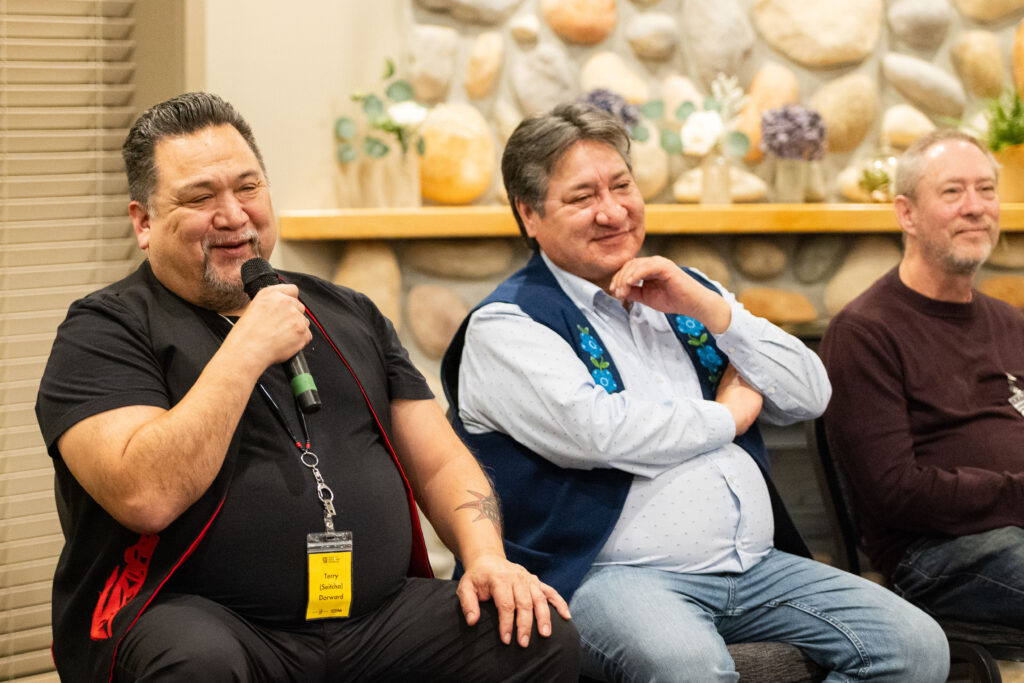
Pictured above (from left-right), Terry Dorward – West Coast Conservation Director, IISAAK OLAM Foundation; Steven Nitah – Managing Director First 30×30 Canada & Nature For Justice; Eric Angel – General Manager, Salmon Parks Stewardship Society. Credits: Jamie Frith
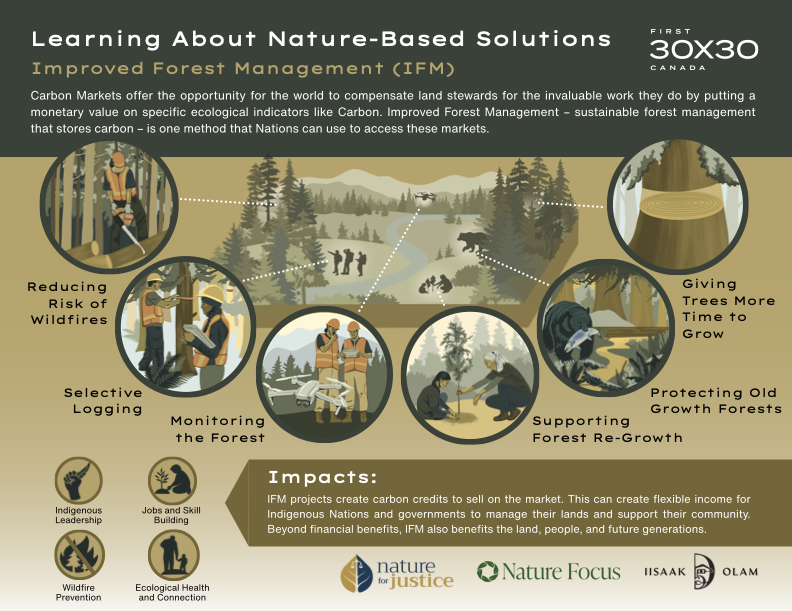
Improved Forest Management (IFM) is a proven Nature-Based Solution (NBS) and approach that reduces wildfire risks, protects old-growth forests, promotes regrowth, and allows trees to mature fully. Beyond environmental benefits, IFM generates carbon credits that support Indigenous leadership, create jobs, and strengthen community well-being.
At First 30×30 Canada, we highlight how these solutions protect the land, empower communities, and ensure a resilient future.
Connect with the First 30×30 Canada team to learn more about Nature-Based Solutions and Improved Forest Management.
Ontario’s Bill 5, passed on June 04, shifts land-use planning powers to the provincial government. Though Bill 5may be framed as a tool for efficiency, Bill 5 overlooks the leadership, capacity, and vision Indigenous Nations bring to the table. Ultimately setting the stage for conflict and confusion that could slow development. The risks of Bill 5 undermine progress towards collaborative, Nation-informed planning that is essential to both meeting conservation targets and honouring Indigenous land stewardship and Canada’s goals for reconciliation.
At First 30×30 Canada, we believe that reconciliation is not a checkbox, it’s a commitment to relationships, respect, and repair. Any path toward meeting Canada’s 30×30 conservation goals must also confront the colonial legacy of land dispossession and center Indigenous leadership. Promising examples of this commitment in action are emerging across Canada, where partnerships with Indigenous Nations are accelerating land-use planning and recognizing the authority of Indigenous Protected and Conserved Areas (IPCAs), including notable relationships in British Columbia.
Indigenous Protected and Conserved Areas (IPCAs) offer a roadmap for meeting conservation targets while also rebuilding nation-to-nation relationships. IPCAs reflect Indigenous governance, cultural practices, and inherent rights and responsibilities that have sustained the lands and waters since time immemorial.
British Columbia: A Promising Example
In contrast to Bill 5, British Columbia is advancing reconciliation by working with Indigenous Nations to fast-track land-use planning in and around IPCAs. This approach supports Indigenous governments in protecting sacred and significant places within their territories, re-affirming that certainty for any land-use initiatives can only be achieved through respectful and sustained Indigenous relationships.
Through dialogue with mining industries, we have learned that protected areas are being established faster, and development projects are more likely to move forward when there is certainty from all parties involved, including Indigenous consent. Bill 5 undermines this certainty by centralizing decisions and bypassing Indigenous jurisdiction, leading to conflict, violation of trust and treaty, and creating challenges that ultimately slow development . British Columbia’s example illustrates that real progress comes from upholding Indigenous law, governance, and stewardship, not from exclusion.
We call on all levels of government to:
Uphold the United Nations Declaration on the Rights of Indigenous Peoples (UNDRIP), including the right to Free, Prior, and Informed Consent (FPIC);
Support the establishment and long-term funding of IPCAs across the country;
Foster genuine partnerships with Indigenous Nations through co-governance and recognition of Indigenous law;
Invest in Nation-led planning that prioritizes both ecological integrity and cultural continuity.
Indigenous Resurgence in Conservation
If we are to meet our national 30×30 goals in a meaningful way, we must do so with humility and a deep commitment to Indigenous sovereignty. Conservation includes people, stories, and systems of respect and understanding that have protected these lands for generations.
We invite Ontario and other jurisdictions to look to IPCAs and the leadership happening in British Columbia, not as a model to replicate, but as a reminder that development, reconciliation, conservation, and Indigenous resurgence can, and must, go hand in hand.