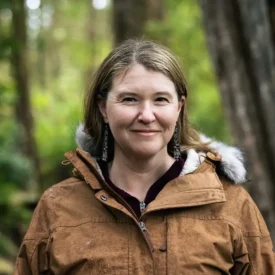
By Robin Barr
“Introducing myself in a good way” is something I’ve learned over the past year working alongside Indigenous Nations in Canada. It’s an introduction that goes beyond a name or job title—one that reflects where I come from, the lands I live on, and the deeper story of my ancestry.
Listening to others share in this way has inspired me to learn more about my own story. Through this process, I have come to understand how interconnected we all are.
My name is Robin Barr. I live in Seattle, on the lands of the Duwamish, Muckleshoot, and Coast Salish peoples. I was born in Omak, Washington, adjacent to the Confederated Tribes of the Colville Reservation and grew up in Davenport, the traditional territory of the Spokane Indians, and Sequim, home to the Jamestown S’klallam Tribe. Each place I’ve lived holds a special place in my heart, shaping who I am and how I understand the world.
As a teenager, I lived briefly in Northern India before attending Washington State University on the lands of the Nimíipuu (Nez Perce) Tribe and the Palus (or Palouse) Band of Indians. That region is also where my family’s roots run deep. I am a fifth-generation Washingtonian, with family ties across the Yakima Valley, home to the Yakama Nation.
My father, a lifelong civil rights advocate, influenced my understanding of justice early on. His college thesis examined land taken from Yakama Nation members who served in World War II, only to return and find the government had leased it out to white farmers under 100-year leases in their absence. This history of injustice—and many others—continues to shape how I think about responsibility and relationship.
I’m appreciative of the people and teachings that have changed how I see the natural world. From early experiences listening to Dayton Edmonds, an Caddo storyteller, to later reading Braiding Sweetgrass – I began to understand the difference between learning about nature and learning from it; the difference between viewing the natural world as kin, rather than ‘other’.
I’ve come to believe that we are guided by the stories we carry. The way we understand the world shapes how we act within it. If our systems are harming the earth, it may be because the stories we’ve been told—and tell ourselves—are incomplete or misaligned.
If we want to live differently, we need to learn new stories.
Indigenous knowledge systems hold many of those alternative stories —grounded in long-term relationship, reciprocity, and respect for place. Growing up near the temperate rainforests of the Pacific Northwest, I felt awe for those landscapes. Over time, I came to understand they were not just preserved, but stewarded for generations by Coast Salish peoples, whose relationships have co-evolved since time immemorial (making my 5th-generation family ties seem very young in comparison.)
We are fortunate that this in-depth knowledge for how to care for specific places and that the communities and cultures that know how to do this work continue to exist, despite centuries of attempted erasure. There is a responsibility to ensure they are supported and sustained.
For me, this is ongoing work. I hope to contribute by listening, learning, and supporting Indigenous leadership with humility and respect.
Because introducing myself in a good way isn’t just about where I begin—it’s about how I choose to move forward.